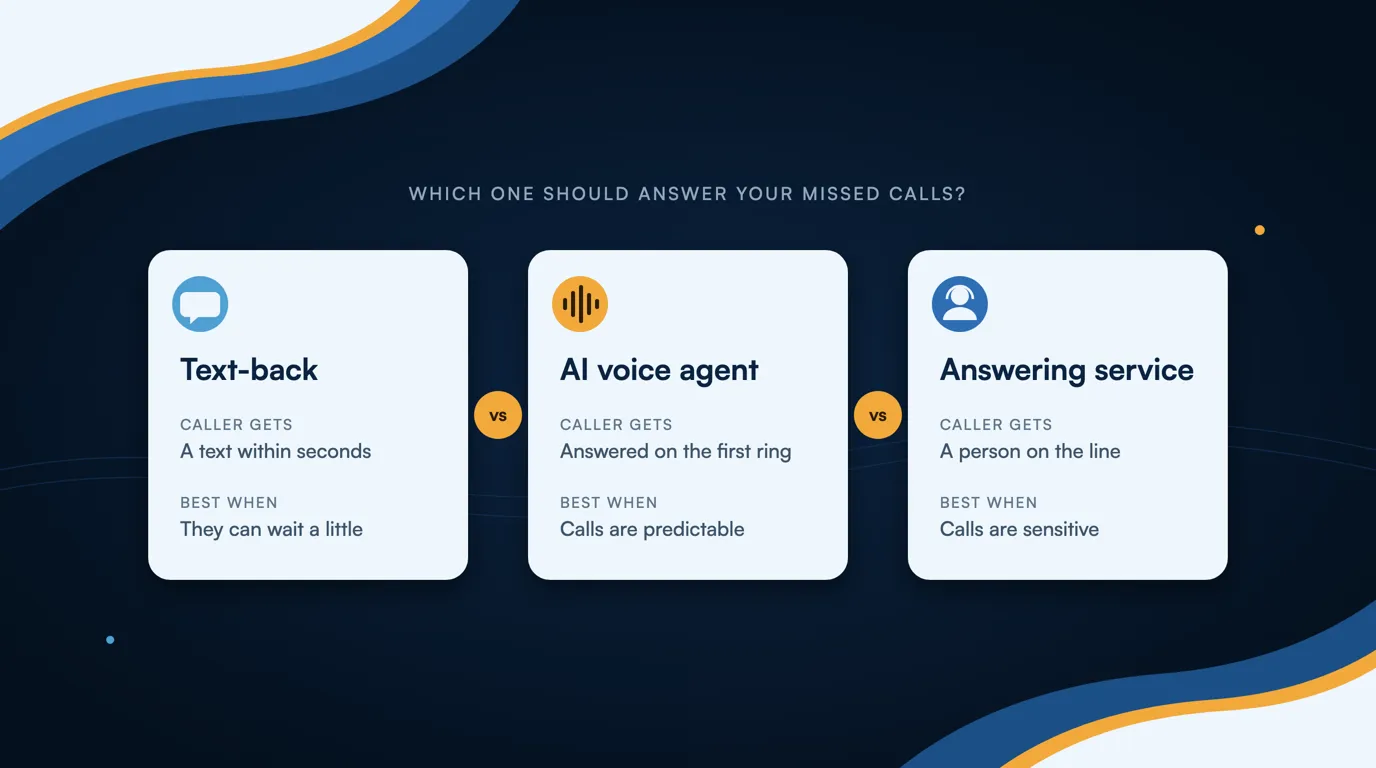
If your callers can wait a few minutes, a missed-call text-back is usually enough. If they need an answer now, or they’d rather talk than text, they need a voice: an AI voice agent when the calls are predictable and come at all hours, or a person when they’re sensitive or complex. Many businesses use both automated options together: the voice agent answers first, and a text-back catches anything that still slips through.
We build both the text-back and the voice agent for Australian service businesses, so here’s how we’d choose between them.
How does each one work?
A missed-call text-back sends the caller a text a few seconds after their call rings out: “Sorry we missed you, it’s Dave from Coastal Plumbing. What can we help with?” The caller replies by text, and you, or an AI, carry on the conversation from there. Nothing answers the call itself.
An AI voice agent answers the call on the first ring. It talks with the caller in a natural voice, answers questions from information you’ve approved, takes the details and can book the job into your calendar. Anything it can’t handle goes to you, with a summary of the call.
An answering service is a team of people who answer your line in your business name. They take a message, and on some plans they book appointments or put urgent calls through to you.
How do they compare?
| Text-back | AI voice agent | Answering service | |
|---|---|---|---|
| What the caller gets | A text seconds after the call rings out | The call answered on the first ring by an AI | The call answered by a person |
| Answers questions | Only once someone texts back | Yes, from what you’ve approved | Yes, within their script |
| Books the job | Usually needs a reply from you | Yes, into your calendar | On some plans; often takes a message |
| After hours | Yes | Yes | Yes, usually at a higher rate |
| Urgent calls | Weak: an urgent caller won’t wait for a text | Good, if it passes urgent calls to whoever is on call | Good: a person can judge urgency |
| Main risk | Marketing texts need to follow the Spam Act | Must say it’s AI; you own what it tells callers | Cost per call; you still have to call back |
| Setup | Minutes to days | Days to weeks | A few days |
For prices, see our list of 12 ways to stop losing missed calls, where every price was checked on the provider’s own site.
What’s the one question that decides it?
Would your callers rather talk or text, and can they wait?
Someone booking a carpet clean next fortnight is happy to text. Someone with water coming through the ceiling isn’t: they want a voice now, and if they don’t get one, they’ll ring the next business. Most businesses get a mix, so think about the calls that matter most to you, the ones that turn into your best jobs.
Which suits your business?
- Urgent jobs (emergency plumbing, electrical faults, locksmiths, burst pipes): a voice, whether that’s an AI voice agent that passes urgent calls straight to whoever is on call, or a 24/7 answering service. A text-back alone is too slow here.
- Routine bookings and quotes (cleaning, landscaping, pest control, beauty): a text-back is often enough, and it’s the simplest to set up.
- Lots of after-hours calls with the same few questions (opening hours, service areas, availability, booking): an AI voice agent. It answers every one, books the job and doesn’t get tired at 10pm.
- Sensitive, complex or high-value calls (legal, medical, big renovations): a person. Callers want judgement and reassurance, and that’s still a human job.
- Callers who’d rather not text, including many older customers: a voice, AI or human.
- Not sure? Start with a text-back. If the replies show callers wanted to talk, or you’re losing urgent jobs, add a voice agent in front of it.
Will an AI voice agent sound robotic?
A good one doesn’t, but it’s worth knowing what makes one sound robotic, because it’s usually not the voice. Modern AI voices sound natural. What gives an agent away is:
- Pauses. In conversation, people answer each other almost instantly. A delay that wouldn’t matter in a text feels awkward on a call, and callers notice it before they notice anything else.
- Talking over the caller, or not letting them interrupt.
- Ignoring what was just said and pushing on with a script.
- Getting stuck instead of handing over to a person.
Two more things matter just as much:
- It should say it’s an AI up front. Something like “Hi, you’ve reached Coastal Plumbing. I’m the AI assistant, how can I help?” Australian Government guidance on using AI says people should know when they’re interacting with AI. It’s also simply honest, and callers are more forgiving of an assistant that’s upfront than one that pretends.
- It should only say what you’ve approved. Your business is responsible for what its AI tells customers, the same as anything a staff member says. In a well-known Canadian case, an airline was held responsible when its website chatbot gave a customer the wrong refund information. So a voice agent should quote your approved prices, areas and call-out fees, and hand anything else to you.
The best test is to ring it yourself, then ask a few customers to try it, with real questions, background noise and interruptions.
What are the risks with each?
- Text-back: a plain “sorry we missed you” text is simple. Once it offers a booking or a deal, it can count as a marketing message under the Spam Act, so it needs your business name and a way to opt out. (What the Spam Act allows.) And an urgent caller may not wait for it.
- AI voice agent: it needs setting up properly with your services, prices and booking rules, and testing before it goes live. It should say it’s AI and only say what you’ve approved. If calls are recorded, it should tell callers.
- Answering service: the cost is per call, so it rises in a busy month, and most plans take a message, which means you still have to call back.
How Brightwater Digital does it
Our Every Call Answered system can be set up as a text-back, an AI voice agent or both, connected to your existing business number and booking calendar. We recommend the voice agent only where your callers would rather talk than text. Where a text-back will do the job, we’ll tell you. Either way, it answers questions, books the job and hands anything complex to you with the full context.
For more on how voice agents work, see AI voice agents explained. For ways to cover your phone over the holidays, see what happens to your calls over the Christmas shutdown.
Sources
- National AI Centre: Guidance for AI adoption (Practice 4, “Share essential information”)
- American Bar Association: tribunal confirms companies remain liable for information provided by their chatbot (Moffatt v Air Canada)
- Stivers and others: Universals and cultural variation in turn-taking in conversation (PNAS)
- ACMA: Avoid sending spam