You can text an old customer or quote lead in Australia only if they agreed to receive marketing messages from your business, or they’re a current customer and the text is about what they already have from you. An old quote or a one-off enquiry, on its own, usually isn’t enough. That’s the effect of the Spam Act 2003 and the guidance from the Australian Communications and Media Authority (ACMA), and it applies to every business, however small.
This guide is for Australian service businesses (trades, clinics and the like) sitting on a list of old quotes, enquiries and past customers. It’s general information, not legal advice.
What counts as a marketing text?
A text is a marketing (or “commercial”) message under the Spam Act if any of its purposes is to offer, advertise or promote your services or your business. It doesn’t have to be a hard sell. “Hi Mark, still keen on that hot water quote? We’ve got Thursday free” offers a service, so it’s a marketing text.
The same rules cover emails, texts and instant messages. Phone calls are covered by separate rules, explained below.
When can I text an old customer?
You can text a past customer when you have one of two kinds of consent:
- Express consent: they ticked a box, signed a form or said yes (in person or on the phone) to getting marketing messages from you. This is the safest kind. Keep a record of who agreed, when and how, because it’s up to the business to prove consent.
- Inferred consent: they have a current, ongoing relationship with your business, such as a service plan, an account or a membership, and the message relates directly to it. A text reminding a service-plan customer that their annual service is due fits. A text selling them something unrelated doesn’t.
ACMA says inferred consent doesn’t cover sending messages to someone who has simply bought something from you once. A finished job with nothing ongoing is closer to a one-off purchase than a relationship.
What about someone who only asked for a quote?
Someone who asked for a quote and never went ahead usually hasn’t given consent to marketing texts. They gave you their number to get a quote, not to hear from you whenever you like. ACMA’s guidance says one-off contact isn’t enough to infer consent, and neither is a relationship that has ended. It hasn’t published a ruling on quote requests specifically, so if you’re unsure, assume you need express consent.
Some agencies selling “database reactivation” say past enquirers generally count as inferred consent. That’s looser than ACMA’s guidance. ACMA’s SpinTel case in November 2026 shows how it treats the “past relationship” argument (see below).
Can I text them to ask if they’re happy to hear from me?
No. ACMA says you can’t send an electronic message to ask for consent, because that message is itself marketing. Consent has to come first, through a form, a tick-box, a phone call or face to face.
What must every marketing text include?
Even with consent, every marketing text must:
- Say who it’s from: your business’s legal name, or your name and ABN.
- Include contact details that stay correct for at least 30 days.
- Offer a free, easy way to unsubscribe, such as “Reply STOP”. The option must keep working for 30 days, can’t require a login or extra details, and requests must be honoured within 5 working days.
One practical catch: texts sent from a branded sender name (like “CoastalPlumb”) usually can’t receive replies, so “Reply STOP” won’t work from one. Use a number that takes replies, or give another way to opt out.
Is a “your quote is about to expire” text marketing?
Possibly not, but be careful. The Spam Act exempts messages that contain only factual information, plus the sender’s details. A bare “Your quote #123 from 3 March expires on 30 November” might fit. Add “Want to lock it in?” or a booking link, though, and it’s promoting your services again. Calling a message “factual” or “transactional” doesn’t make it so. Get legal advice before relying on this.
Can I call old quotes instead of texting them?
Yes, often, but calls have their own rules: the Do Not Call Register Act 2006 and the telemarketing industry standard.
- Check the Do Not Call Register first. You can’t make a marketing call to a number on the Register without consent. Checking (called “washing”) a list is free for up to 500 numbers a year, and a checked number can be called for 30 days.
- Call within the allowed hours: weekdays 9am–8pm and Saturdays 9am–5pm, at the time where the person lives. No calls on Sundays, or on New Year’s Day, Australia Day, Good Friday, Easter Monday, Anzac Day, Christmas Day or Boxing Day.
- Say who you are and why you’re calling at the start, give contact details if asked, keep caller ID on, and end the call as soon as the person asks.
- AI voice calls follow the same rules. A synthetic voice is still a telemarketing call, and the call must give the person a way to ask for the business’s contact details.
The Register covers calls and faxes, not texts. A number that isn’t on the Register still can’t be sent marketing texts without consent.
Does consent run out after 3 months?
For texts and emails, there’s no fixed expiry, but don’t rely on old consent the person wouldn’t expect to still apply. The 3-month rule people quote comes from the Do Not Call Register Act, and it’s about phone calls: express consent to calls lapses after 3 months unless it says how long it lasts. That’s why good consent wording says “until I opt out”.
Does the Privacy Act matter for a small business?
Most businesses with turnover under $3 million are still exempt from most of the Privacy Act. The Spam Act has no such exemption: it applies to every business that sends marketing texts or emails, whatever its size.
What if an agency sends the texts for me?
You’re both responsible. Under the Spam Act, being “knowingly concerned” in a breach is itself a breach, so the business and the agency sending on its behalf are both exposed. If someone else sends your messages, you still need consent from every person who receives them.
What happens if you get it wrong?
ACMA enforces these rules actively. In November 2026, SpinTel paid a $653,400 penalty for sending more than 32,000 marketing emails to former customers, some of whom had left 13 years earlier. SpinTel argued that the past relationship gave it inferred consent, and ACMA rejected that: “a previous business relationship did not automatically provide consent”. ACMA says businesses have paid over $11 million in spam penalties in the last 18 months.
So who can I contact, and how?
| Contact | Text them? | Call them? |
|---|---|---|
| Ticked a consent box or said yes to marketing | Yes, within what they agreed to | Yes, within calling hours |
| Current customer (service plan, account), message about that service | Usually yes | Yes, within calling hours |
| Asked for a quote, nothing since | Usually no | Yes if not on the Register (check first), or with consent |
| Past customer, job finished, nothing ongoing | Usually no | Yes if not on the Register (check first), or with consent |
| Unsubscribed or asked you to stop | No | Not for marketing: ACMA says don’t contact people who unsubscribed to win them back |
| Number found in a directory or online listing | No (a published number isn’t consent) | Only if not on the Register, or with consent |
How do I make next year’s old quotes contactable?
Add a consent box to every quote and enquiry form, starting now. It should be unticked by default, separate from your terms, and say who will contact them, how (texts, emails, calls), what about and for how long. For example:
☐ Yes, [Business name] can text, email or call me about this quote and about future offers and reminders for [service], until I opt out. I can reply STOP at any time.
Record every yes: who, when, how and the exact wording they saw. A year from now, every quote that ticked the box can be followed up properly.
How Brightwater Digital handles this
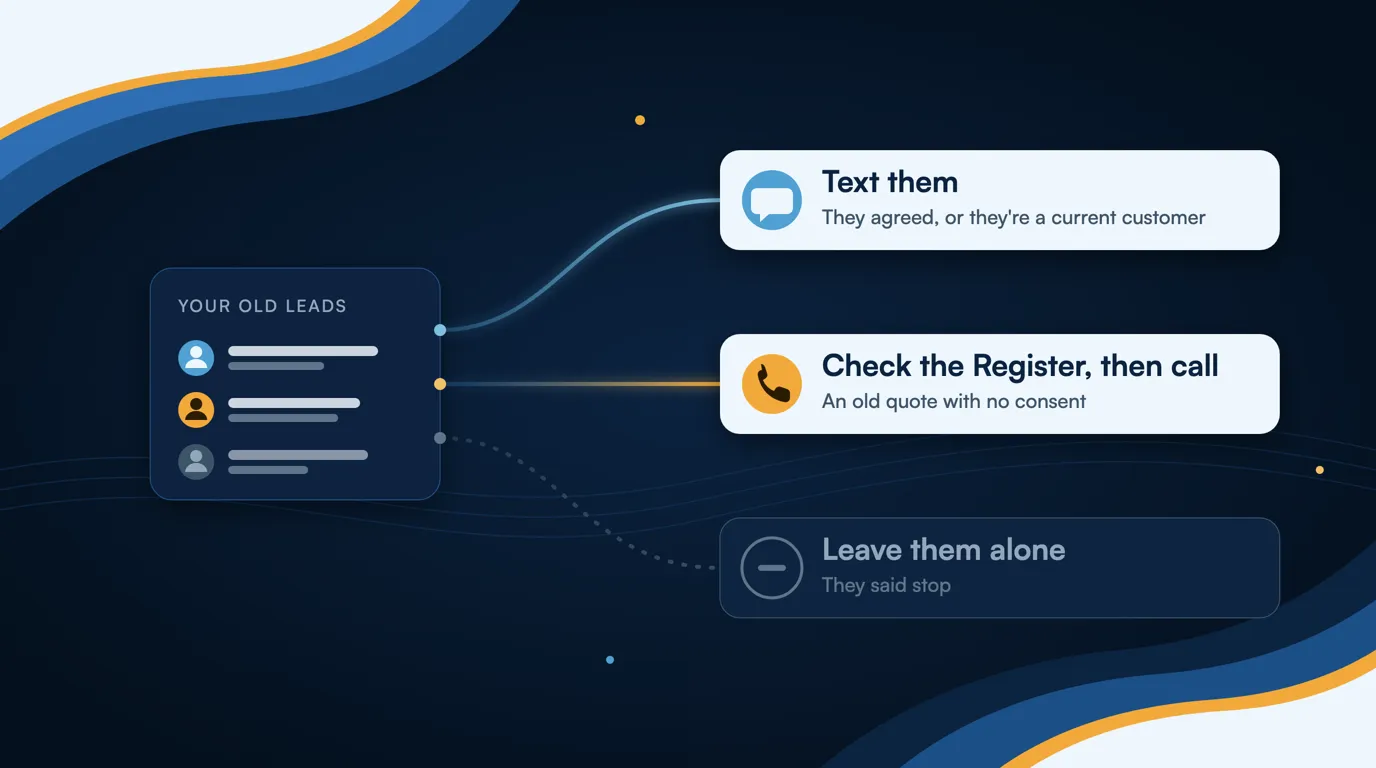
Brightwater Digital’s Wake Up Your Dead Leads system sorts a client’s list before anything is sent: people who agreed to hear from the business, and current customers, get texts with the business’s name and an opt-out; older quotes go on a call list checked against the Do Not Call Register, for the owner to ring; and the client’s quote forms get a consent box.
Sources
- Spam Act 2003 (Federal Register of Legislation)
- Do Not Call Register Act 2006 and the Telemarketing and Research Calls Industry Standard 2017
- ACMA: Avoid sending spam and Consumer consent: expectations for businesses
- ACMA: SpinTel pays $653K penalty for spamming former customers (4 November 2026)
- Do Not Call Register: subscriptions for businesses
- business.gov.au: promoting your business by email or text
Checked against the law and ACMA guidance in November 2026. General information only, not legal advice. For your own situation, talk to an Australian lawyer.