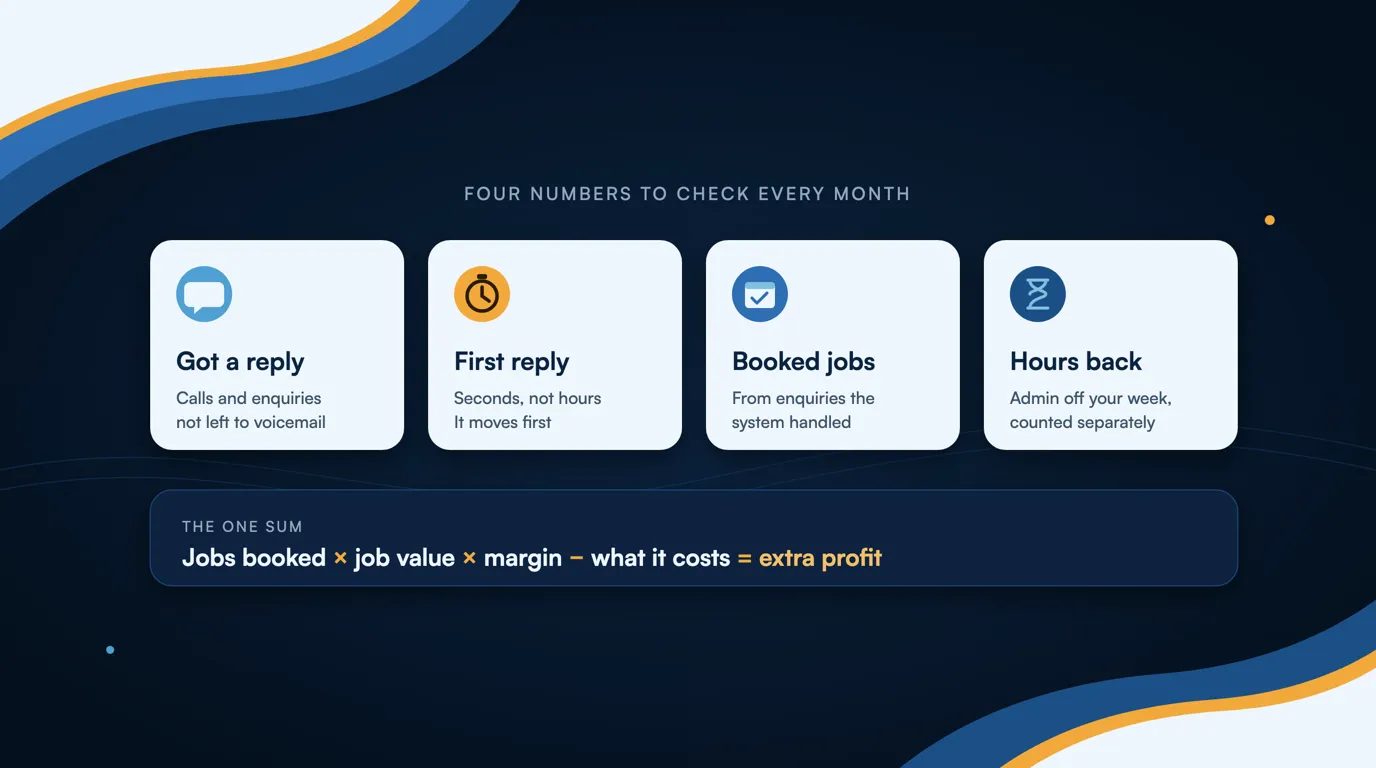
Check four numbers each month: how many calls and enquiries got a reply, how fast the first reply was, how many turned into booked jobs, and how many hours of admin it took off you. Then do one sum: the jobs it booked × your average job value × your margin, minus what the system costs. If that’s positive for two or three months running, it’s making you money.
This is a 15-minute monthly check for Australian service businesses. You don’t need a CRM, a data team or a split test.
What are the four numbers to check every month?
- Calls and enquiries that got a reply. Out of every call, web form and text you received, how many got an answer, a text back or a callback, instead of going to voicemail and nowhere?
- How fast the first reply was. Pick a few typical enquiries and check how long it took for the first reply. Seconds is the goal, not hours or days.
- Enquiries that turned into booked jobs. Specifically, the ones the system handled: a call it answered, a missed call it texted back, a quote it followed up, an old customer it got back in touch with.
- Hours of admin it took off you. Time you used to spend returning calls, chasing quotes and typing up messages.
These are the four measures Brightwater Digital judges its systems on, because they’re the ones that reach the bank. Open rates and message counts don’t.
What’s the one sum?
Extra profit = jobs the system booked × your average job value × your margin − what the system costs that month.
Here’s a worked example. The numbers are made up, to show the maths. They aren’t a client result.
- Jobs booked through the system this month: 6
- Average job value: $450
- Your margin on a typical job: 40%
- What the system costs per month: $300
6 × $450 × 40% = $1,080 profit, minus $300 = $780 ahead this month.
Use your own numbers. Your accountant or your job software can tell you your average job value and margin. If you’d like a sense-check, the ATO publishes small business benchmarks by industry, such as plumbing services, but they’re ranges for comparison, not your margin.
Where do I find these numbers?
- Calls: your phone’s call history or your carrier’s online account shows calls received and missed.
- Web enquiries and texts: your inbox, your website form emails and your messages.
- Jobs booked: your job software or calendar. The easiest trick is to tag every job the system books, for example with “AI” in the job source, so you can count them at the end of the month.
- Speed of first reply: look at the time an enquiry came in and the time of the first reply, for a handful of them.
- Ask: “How did you get hold of us?” when you book a job. It takes five seconds and tells you a lot.
How do I know the AI caused it?
Big companies split their leads into two groups and compare. With 40 enquiries a month, you can’t, so keep it simple and honest:
- Compare like with like: this month against the same month last year, or against the three months before you started. Trades are seasonal, so a heatwave or a wet month can swing the numbers either way.
- Only count what it clearly caught: a call that would have gone to voicemail, a quote that was going cold, an old customer it brought back. Don’t count an existing customer who’d have rung back anyway.
- Give it two or three months before you judge it. One month is too small to tell.
Why is speed of first reply the number to watch?
Because it moves first. Bookings take a while to show a trend, but your first reply time changes the day the system goes live. If it drops from hours to seconds and stays there, more of your enquiries are reaching you before they ring someone else, and the bookings should follow within a month or two. If it doesn’t drop, something isn’t set up right, and you’ll know early.
What about the hours it saves?
Count them, but separately. Hours saved only turn into money if you use them for paid work or for time you’d value anyway, like knocking off earlier. So keep “extra profit” and “hours back” as two different numbers. Both matter. Just don’t add them together.
What should it cost?
Count the full cost: the monthly fee, any usage charges (text messages, call minutes) and any setup fee, spread over a year. Then put that into the sum above. If you’re comparing options, here are 12 ways to stop losing missed calls, with prices checked on each provider’s website.
The same check works for following up old leads. Count the replies, the jobs booked and the opt-outs from each round. (What is lead reactivation?)
How Brightwater Digital measures it
We measure what reaches your bank, not open rates or impressions. See how we work.
Sources
The worked example uses made-up numbers to show the maths. Your results will depend on your business.